Abstract:
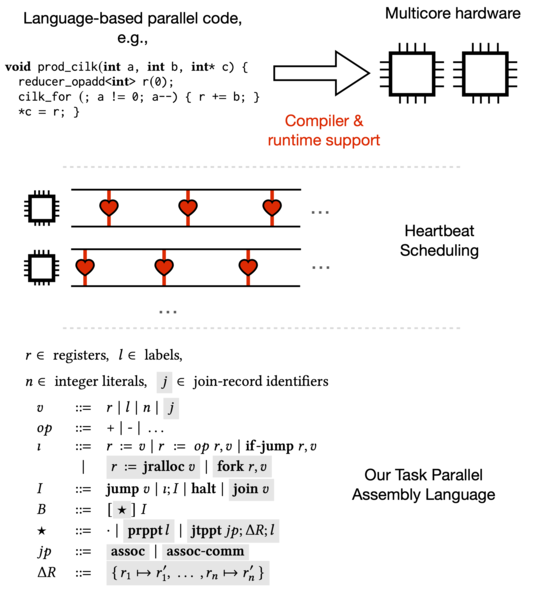
Achieving parallel performance and scalability involves making compromises between parallel and sequential computation. If not contained, the overheads of parallelism can easily outweigh its benefits, sometimes by orders of magnitude. Today, we expect programmers to implement this compromise by optimizing their code manually. This process is labor intensive, requires deep expertise, and reduces code quality. Recent work on heartbeat scheduling shows a promising approach that manifests the potentially vast amounts of available, latent parallelism, at a regular rate, based on even beats in time. The idea is to amortize the overheads of parallelism over the useful work performed between the beats. Heartbeat scheduling is promising in theory, but the reality is complicated: it has no known practical implementation. In this paper, we propose a practical approach to heartbeat scheduling that involves equipping the assembly language with a small set of primitives. These primitives leverage existing kernel and hardware support for interrupts to allow parallelism to remain latent, until a heartbeat, when it can be manifested with low cost. Our Task Parallel Assembly Language (TPAL) is a compact, RISC-like assembly language. We specify TPAL through an abstract machine and implement the abstract machine as compiler transformations for C/C++ code and a specialized run-time system. We present an evaluation on both the Linux and the Nautilus kernels, considering a range of heartbeat interrupt mechanisms. The evaluation shows that TPAL can dramatically reduce the overheads of parallelism without compromising scalability.