17/08/2020

Automatic structure synthesis for 3D woven relief

Rundong Wu, Claire Harvey, Joy Xiaoji Zhang, Sean Kroszner, Brooks Hagan, Steve Marschner

Keywords: fabrication, 3D weaving

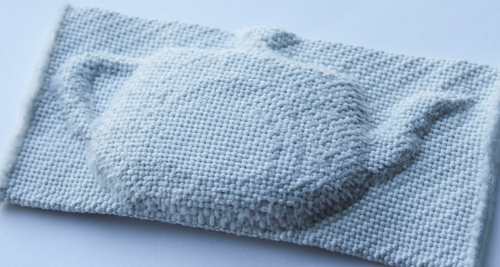
Abstract: 3D weaving is a manufacturing technique that creates multilayer textiles with substantial thickness. Currently, the primary use for these materials is in regularly structured carbon-polymer or glass-polymer composites, but in principle a wide range of complex shapes can be achieved, providing the opportunity to customize the fiber structure for individual parts and also making 3D weaving appealing in many soft-goods applications. The primary obstacle to broader use is the need to design intricate weave structures, involving tens to hundreds of thousands of yarn crossings, which are different for every shape to be produced. The goal of this research is to make 3D weaving as readily usable as CNC machining or 3D printing, by providing an algorithm to convert an arbitrary 3D solid model into machine instructions to weave the corresponding shape. We propose a method to generate 3D weaving patterns for height fields by slicing the shape along intersecting arrays of parallel planes and then computing the paths for all the warp and weft yarns, which travel in these planes. We demonstrate the method by generating weave structures for different shapes and fabricating a number of examples in polyester yarn using a Jacquard loom.

The video of this talk cannot be embedded. You can watch it here:
https://dl.acm.org/doi/10.1145/3386569.3392449#sec-supp
(Link will open in new window)
 0
 0
 0
 0
This is an embedded video. Talk and the respective paper are published at SIGGRAPH 2020 virtual conference. If you are one of the authors of the paper and want to manage your upload, see the question "My papertalk has been externally embedded..." in the FAQ section.

Comments

Post Comment
no comments yet
code of conduct: tbd

Similar Papers