08/12/2020

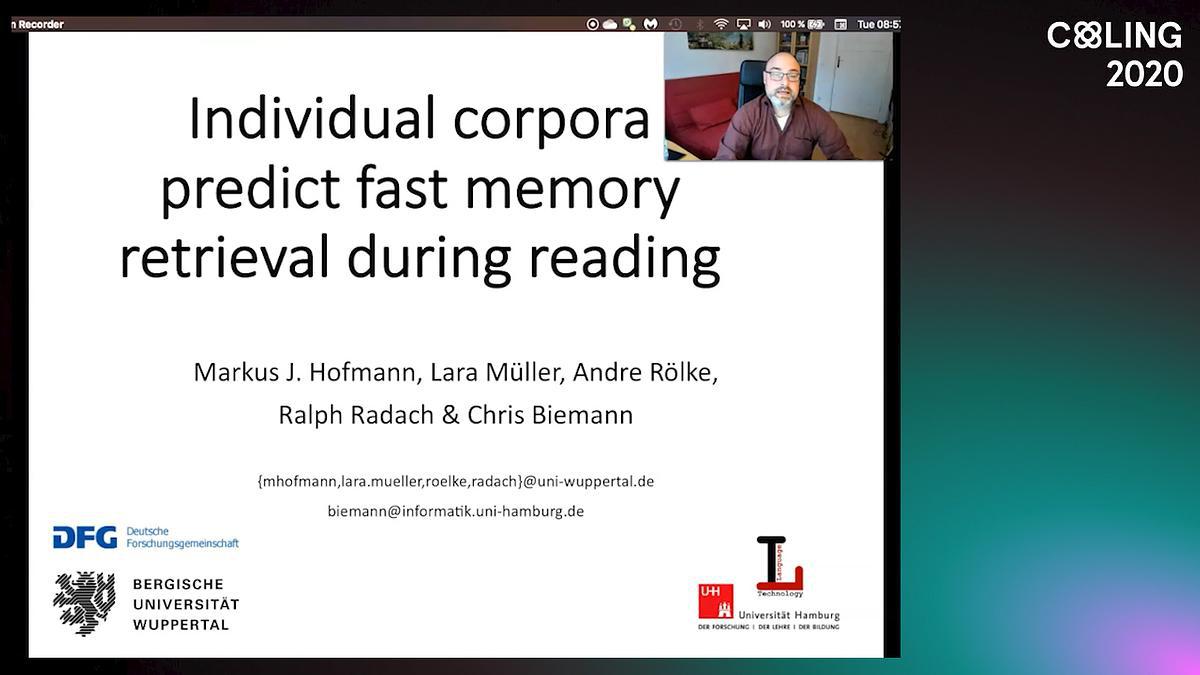
Individual corpora predict fast memory retrieval during reading

Markus J. Hofmann, Lara Müller, Andre Rölke, Ralph Radach, Chris Biemann

Keywords:

Abstract: The corpus, from which a predictive language model is trained, can be considered the experience of a semantic system. We recorded everyday reading of two participants for two months on a tablet, generating individual corpus samples of 300/500K tokens. Then we trained word2vec models from individual corpora and a 70 million-sentence newspaper corpus to obtain individual and norm-based long-term memory structure. To test whether individual corpora can make better predictions for a cognitive task of long-term memory retrieval, we generated stimulus materials consisting of 134 sentences with uncorrelated individual and norm-based word probabilities. For the subsequent eye tracking study 1-2 months later, our regression analyses revealed that individual, but not norm-corpus-based word probabilities can account for first-fixation duration and first-pass gaze duration. Word length additionally affected gaze duration and total viewing duration. The results suggest that corpora representative for an individual’s long-term memory structure can better explain reading performance than a norm corpus, and that recently acquired information is lexically accessed rapidly.

The video of this talk cannot be embedded. You can watch it here:
https://underline.io/lecture/6474-individual-corpora-predict-fast-memory-retrieval-during-reading
(Link will open in new window)
 0
 0
 0
 0
This is an embedded video. Talk and the respective paper are published at COLING Workshops 2020 virtual conference. If you are one of the authors of the paper and want to manage your upload, see the question "My papertalk has been externally embedded..." in the FAQ section.

Comments

Post Comment
no comments yet
code of conduct: tbd

Similar Papers