08/12/2020

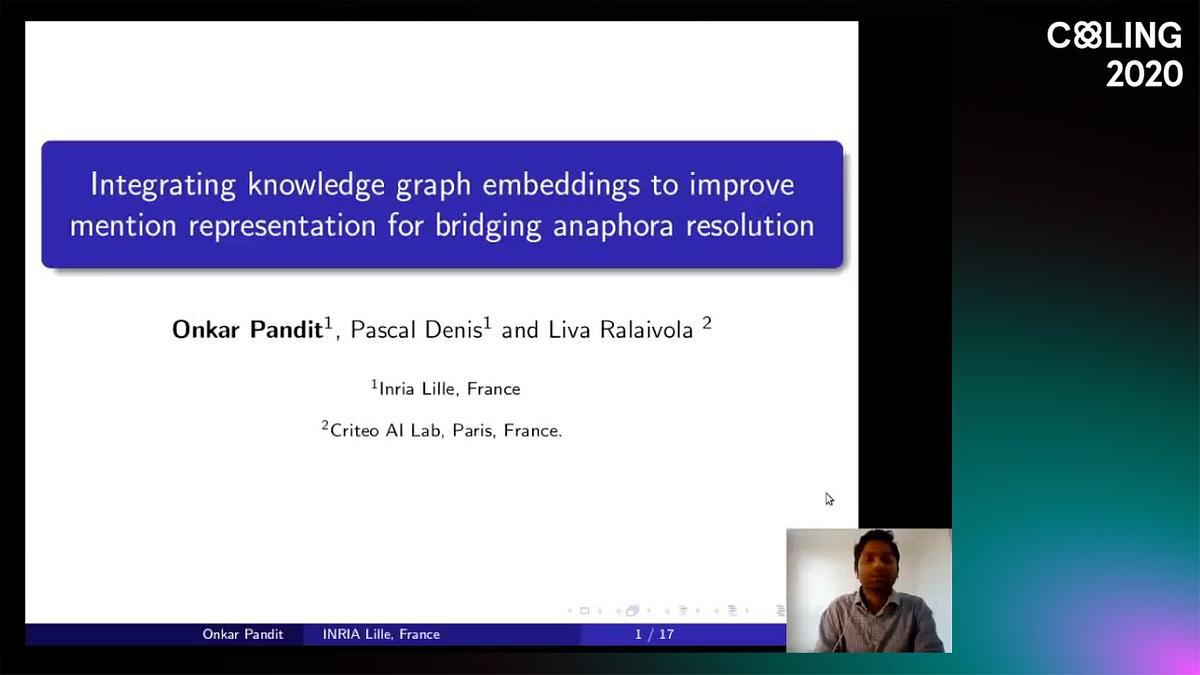
Integrating knowledge graph embeddings to improve mention representation for bridging anaphora resolution

Onkar Pandit, Pascal Denis, Liva Ralaivola

Keywords:

Abstract: Lexical semantics and world knowledge are crucial for interpreting bridging anaphora. Yet, existing computational methods for acquiring and injecting this type of information into bridging resolution systems suffer important limitations. Based on explicit querying of external knowledge bases, earlier approaches are computationally expensive (hence, hardly scalable) and they map the data to be processed into high-dimensional spaces (careful handling of the curse of dimensionality and overfitting has to be in order). In this work, we take a different and principled approach which naturally addresses these issues. Specifically, we convert the external knowledge source (in this case, WordNet) into a graph, and learn embeddings of the graph nodes of low dimension to capture the crucial features of the graph topology and, at the same time, rich semantic information. Once properly identified from the mention text spans, these low dimensional graph node embeddings are combined with distributional text-based embeddings to provide enhanced mention representations. We illustrate the effectiveness of our approach by evaluating it on commonly used datasets, namely ISNotes and BASHI. Our enhanced mention representations yield significant accuracy improvements on both datasets when compared to different standalone text-based mention representations.

The video of this talk cannot be embedded. You can watch it here:
https://underline.io/lecture/6578-integrating-knowledge-graph-embeddings-to-improve-mention-representation-for-bridging-anaphora-resolution
(Link will open in new window)
 0
 0
 0
 0
This is an embedded video. Talk and the respective paper are published at COLING Workshops 2020 virtual conference. If you are one of the authors of the paper and want to manage your upload, see the question "My papertalk has been externally embedded..." in the FAQ section.

Comments

Post Comment
no comments yet
code of conduct: tbd

Similar Papers