08/12/2020

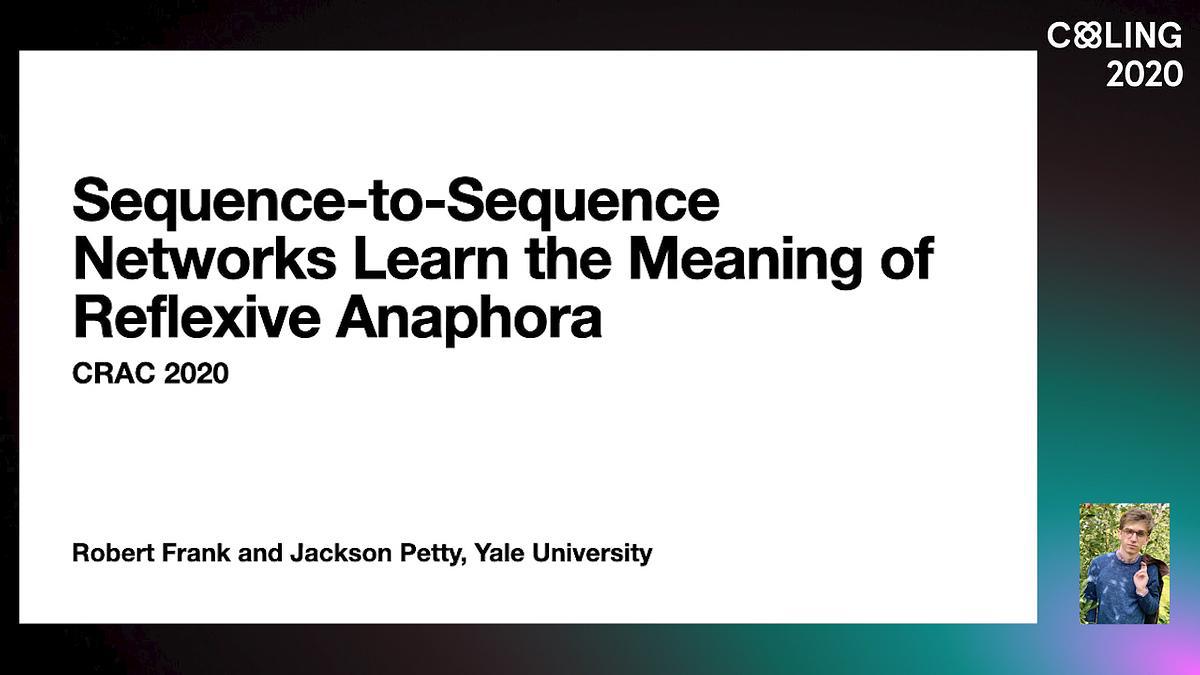
Sequence-to-Sequence Networks Learn the Meaning of Reflexive Anaphora

Robert Frank, Jackson Petty

Keywords:

Abstract: Reflexive anaphora present a challenge for semantic interpretation: their meaning varies depending on context in a way that appears to require abstract variables. Past work has raised doubts about the ability of recurrent networks to meet this challenge. In this paper, we explore this question in the context of a fragment of English that incorporates the relevant sort of contextual variability. We consider sequence-to-sequence architectures with recurrent units and show that such networks are capable of learning semantic interpretations for reflexive anaphora which generalize to novel antecedents. We explore the effect of attention mechanisms and different recurrent unit types on the type of training data that is needed for success as measured in two ways: how much lexical support is needed to induce an abstract reflexive meaning (i.e., how many distinct reflexive antecedents must occur during training) and what contexts must a noun phrase occur in to support generalization of reflexive interpretation to this noun phrase?

The video of this talk cannot be embedded. You can watch it here:
https://underline.io/lecture/6124-sequence-to-sequence-networks-learn-the-meaning-of-reflexive-anaphora
(Link will open in new window)
 0
 0
 0
 0
This is an embedded video. Talk and the respective paper are published at COLING Workshops 2020 virtual conference. If you are one of the authors of the paper and want to manage your upload, see the question "My papertalk has been externally embedded..." in the FAQ section.

Comments

Post Comment
no comments yet
code of conduct: tbd

Similar Papers