08/12/2020

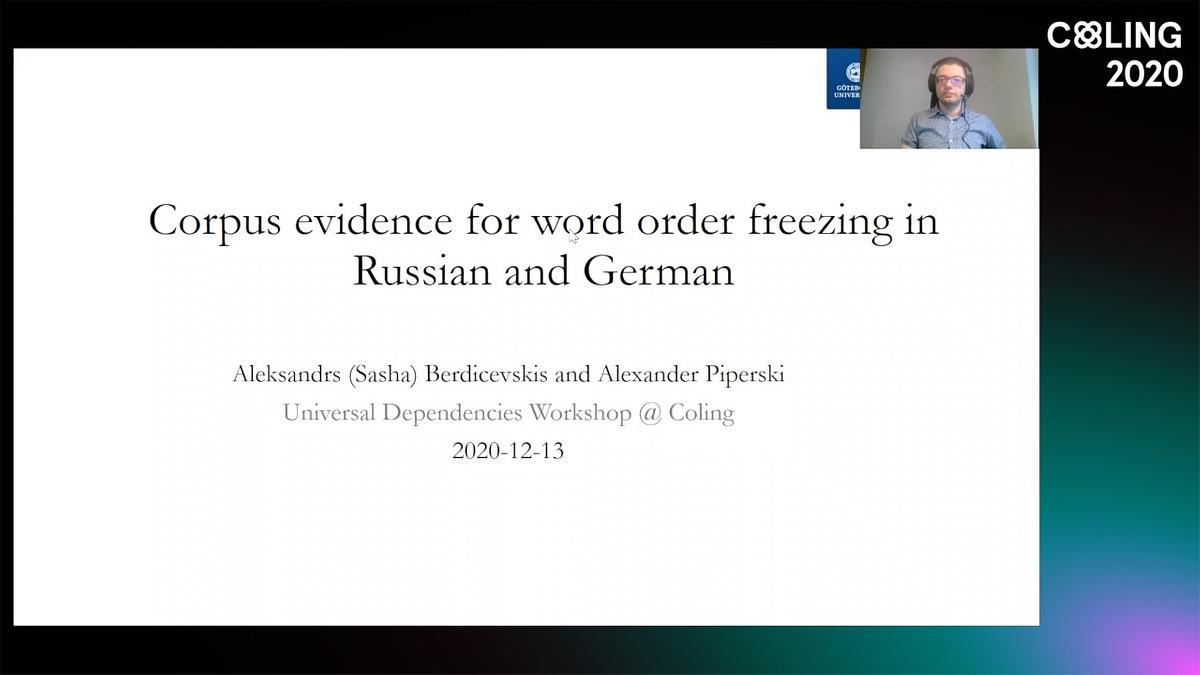
Corpus evidence for word order freezing in Russian and German

Aleksandrs Berdicevskis, Alexander Piperski

Keywords:

Abstract: We use Universal Dependencies treebanks to test whether a well-known typological trade-off between word order freedom and richness of morphological marking of core arguments holds within individual languages. Using Russian and German treebank data, we show that the following phenomenon (sometimes dubbed word order freezing) does occur: those sentences where core arguments cannot be distinguished by morphological means (due to case syncretism or other kinds of ambiguity) have more rigid order of subject, verb and object than those where unambiguous morphological marking is present. In ambiguous clauses, word order is more often equal to the one which is default or dominant (most frequent) in the language. While Russian and German differ with respect to how exactly they mark core arguments, the effect of morphological ambiguity is significant in both languages. It is, however, small, suggesting that languages do adapt to the evolutionary pressure on communicative efficiency and avoidance of redundancy, but that the pressure is weak in this particular respect.

The video of this talk cannot be embedded. You can watch it here:
https://underline.io/lecture/6552-corpus-evidence-for-word-order-freezing-in-russian-and-german
(Link will open in new window)
 0
 0
 0
 0
This is an embedded video. Talk and the respective paper are published at COLING Workshops 2020 virtual conference. If you are one of the authors of the paper and want to manage your upload, see the question "My papertalk has been externally embedded..." in the FAQ section.

Comments

Post Comment
no comments yet
code of conduct: tbd

Similar Papers