25/07/2020

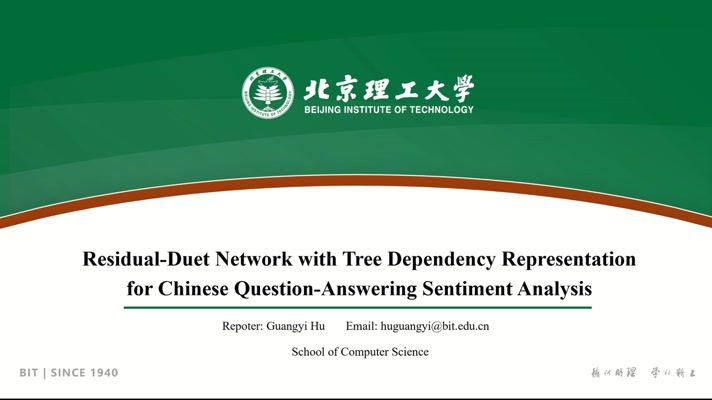
Residual-duet network with tree dependency representation for chinese question-answering sentiment analysis

Guangyi Hu, Chongyang Shi, Shufeng Hao, Yu Bai

Keywords: graph embedding, dependency tree, sentiment analysis, neural network

Abstract: Question-answering sentiment analysis (QASA) is a novel but meaningful sentiment analysis task based on question-answering online reviews. Existing neural network-based models that conduct sentiment analysis of online reviews have already achieved great success. However, the syntax and implicitly semantic connection in the dependency tree have not been made full use of, especially for Chinese which has specific syntax. In this work, we propose a Residual-Duet Network leveraging textual and tree dependency information for Chinese question-answering sentiment analysis. In particular, we explore the synergies of graph embedding with structural dependency links to learn syntactic information. The transverse and longitudinal compression encoders are developed to capture sentiment evidence with disparate types of compression and different residual connections. We evaluate our model on three Chinese QASA datasets in different domains. Experimental results demonstrate the superiority of our proposed model in Chinese question-answering sentiment analysis.

The video of this talk cannot be embedded. You can watch it here:
https://dl.acm.org/doi/10.1145/3397271.3401226#sec-supp
(Link will open in new window)
 0
 0
 0
 0
This is an embedded video. Talk and the respective paper are published at SIGIR 2020 virtual conference. If you are one of the authors of the paper and want to manage your upload, see the question "My papertalk has been externally embedded..." in the FAQ section.

Comments

Post Comment
no comments yet
code of conduct: tbd

Similar Papers