Abstract:
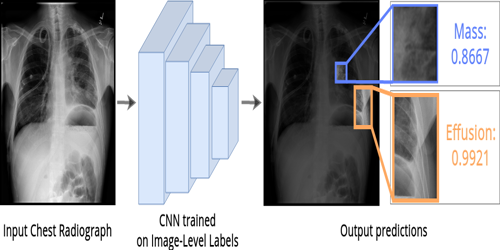
Due to the high complexity of medical images and the scarcity of trained personnel, most large-scale radiological datasets are lacking fine-grained annotations and are often only described on image-level. These shortcomings hinder the deployment of automated diagnosis systems, which require human-interpretable justification for their decision process. In this paper, we address the problem of weakly supervised identification and localization of abnormalities in chest radiographs in a multiple-instance learning setting. To that end, we introduce a novel loss function for training convolutional neural networks increasing the localization confidence and assisting the overall disease identification. The loss leverages both image- and patch-level predictions to generate auxiliary supervision and enables specific training at patch-level. Rather than forming strictly binary from the predictions as done in previous loss formulations, we create targets in a more customized manner.This way, the loss accounts for possible misclassification of less certain instances. We show that the supervision provided within the proposed learning scheme leads to better performance and more precise predictions on prevalent datasets for multiple-instance learning as well as on the NIH ChestX-Ray14 benchmark for disease recognition than previously used losses.