23/08/2020

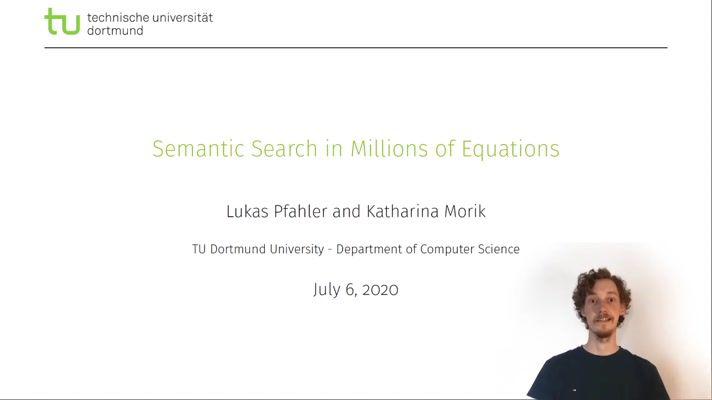
Semantic search in millions of equations

Lukas Pfahler, Katharina Morik

Keywords: graph convolutional neural networks, mathematics retrieval, self-supervised learning, search engine, embedding learning

Abstract: Given the increase of publications, search for relevant papers becomes tedious. In particular, search across disciplines or schools of thinking is not supported. This is mainly due to the retrieval with keyword queries: technical terms differ in different sciences or at different times. Relevant articles might better be identified by their mathematical problem descriptions. Just looking at the equations in a paper already gives a hint to whether the paper is relevant. Hence, we propose a new approach for retrieval of mathematical expressions based on machine learning. We design an unsupervised representation learning task that combines embedding learning with self-supervised learning. Using graph convolutional neural networks we embed mathematical expression into low-dimensional vector spaces that allow efficient nearest neighbor queries. To train our models, we collect a huge dataset with over 29 million mathematical expressions from over 900,000 publications published on arXiv.org. The math is converted into an XML format, which we view as graph data. Our empirical evaluations involving a new dataset of manually annotated search queries show the benefits of using embedding models for mathematical retrieval.

The video of this talk cannot be embedded. You can watch it here:
https://dl.acm.org/doi/10.1145/3394486.3403056#sec-supp
(Link will open in new window)
 0
 0
 0
 0
This is an embedded video. Talk and the respective paper are published at KDD 2020 virtual conference. If you are one of the authors of the paper and want to manage your upload, see the question "My papertalk has been externally embedded..." in the FAQ section.

Comments

Post Comment
no comments yet
code of conduct: tbd

Similar Papers