23/08/2020

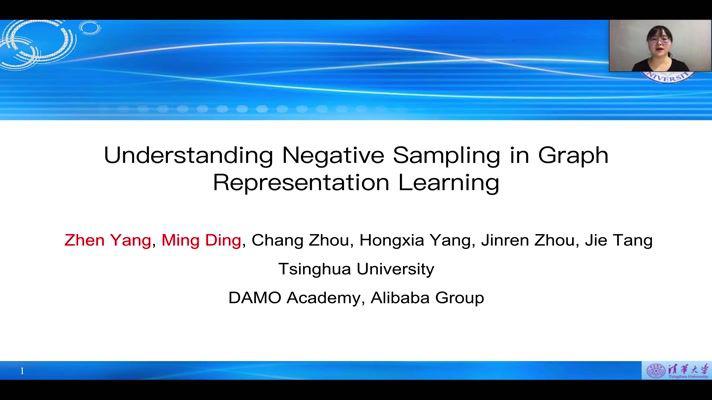
Understanding negative sampling in graph representation learning

Zhen Yang, Ming Ding, Chang Zhou, Hongxia Yang, Jingren Zhou, Jie Tang

Keywords: network embedding, graph representation learning, negative sampling

Abstract: Graph representation learning has been extensively studied in recent years, in which sampling is a critical point. Prior arts usually focus on sampling positive node pairs, while the strategy for negative sampling is left insufficiently explored. To bridge the gap, we systematically analyze the role of negative sampling from the perspectives of both objective and risk, theoretically demonstrating that negative sampling is as important as positive sampling in determining the optimization objective and the resulted variance. To the best of our knowledge, we are the first to derive the theory and quantify that a nice negative sampling distribution is pn(u|v) ∝ pd(u|v)α, 0 < α < 1. With the guidance of the theory, we propose MCNS, approximating the positive distribution with self-contrast approximation and accelerating negative sampling by Metropolis-Hastings. We evaluate our method on 5 datasets that cover extensive downstream graph learning tasks, including link prediction, node classification and recommendation, on a total of 19 experimental settings. These relatively comprehensive experimental results demonstrate its robustness and superiorities.

The video of this talk cannot be embedded. You can watch it here:
https://dl.acm.org/doi/10.1145/3394486.3403218#sec-supp
(Link will open in new window)
 0
 0
 0
 0
This is an embedded video. Talk and the respective paper are published at KDD 2020 virtual conference. If you are one of the authors of the paper and want to manage your upload, see the question "My papertalk has been externally embedded..." in the FAQ section.

Comments

Post Comment
no comments yet
code of conduct: tbd

Similar Papers